The Swiss Data Science Center Opens Headquarters at Biopôle in Lausanne

Share this article
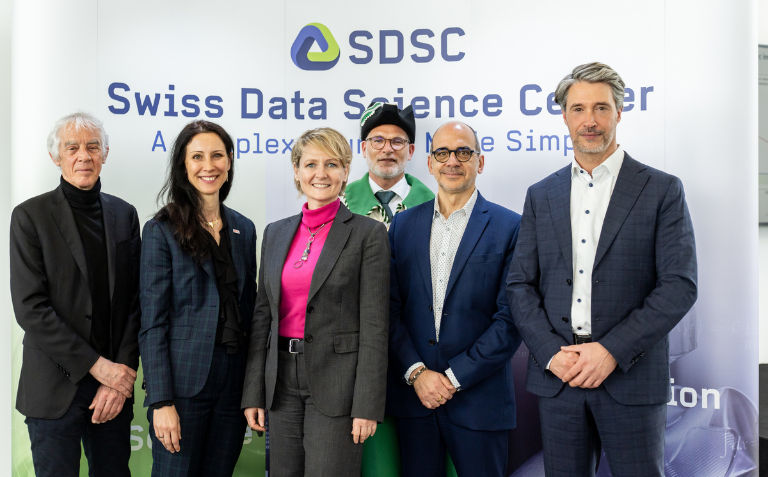
The Swiss Data Science Center (SDSC) inaugurating its headquarters at the Biopôle campus in Lausanne, as part of a strategic partnership with the State of Vaud. This is the first time that SDSC has had a space independent of its partner institutions – EPFL, ETH Zurich, and PSI – thereby strengthening its presence in French-speaking Switzerland. Companies, public authorities, and research institutions in the region will be able to benefit from the expertise of SDSC’s 120 specialists to develop innovative data-driven tools and services.
Founded in 2017 within the ETH Domain, the SDSC is now a National Research Infrastructure in data science and artificial intelligence. Its teams support university laboratories, hospitals, companies, and public administrations throughout the entire data value chain, from data collection and management to machine learning. The new site is located at Biopôle, one of Europe’s largest life sciences innovation campuses, and includes workspaces, training facilities, and themed meeting areas.
« The move to Biopôle is a key step for the SDSC and for the development of data science in the Canton of Vaud and throughout Switzerland. This proximity to cantonal administrations, businesses, universities, and hospitals will enable us to effectively support them in the development of innovative data-driven tools and services. The support of the State of Vaud is playing a decisive role in this new phase. » – Olivier Verscheure, Executive Director of SDSC
A strategic partnership with the Canton of Vaud
The Canton of Vaud is providing CHF 7.5 million in funding to the SDSC for the period 2024–2028 through its Innovation Support Fund. Led by the Service for the Promotion of the Economy and Innovation (SPEI), this partnership is funding a joint innovation program enabling Vaud-based SMEs and public bodies to collaborate with SDSC specialists and academic partners such as EPFL, UNIL, and HEIG-VD. A key objective is to strengthen data analysis and AI skills within the Vaud economic and public sectors.
« This partnership is not just financial support; it also reflects a strategic choice to make our canton a testing ground for artificial intelligence. The goal is to enable economic and public stakeholders in the canton to leverage data to meet their challenges, whether it be renovating our housing stock, monitoring our lakes, or modernizing our healthcare services. » – Isabelle Moret, State Councilor, Head of the Department of Economy, Innovation, Employment, and Heritage (DEIEP)
Concrete projects for the canton
As a result of this collaboration, the ENERBAT pilot project has developed a data-driven methodology to prioritize renovations of the State of Vaud’s building stock. The tool analyzes the technical and geospatial data of each building to recommend targeted strategies for reducing CO2 emissions in line with the Communiqué de presse : Le Swiss Data Science Center inaugure son siège au Biopôle de Lausanne canton’s net-zero target by 2040. In the future, this approach could be extended to real estate portfolios at the regional or national level.
In 2025, the SDSC launched an annual call for projects aimed at companies or consortia bringing together academic and industrial partners based in the canton. Selected projects receive funding of up to CHF 125,000 and benefit from the SDSC’s technical expertise and tailored support in the form of workshops and coaching for companies with less experience in artificial intelligence. These innovation initiatives range from monitoring invasive species in Lake Geneva to tracking river flows, early detection of signs of emotional distress, and the development of AI tools for medical use. The projects selected for the second edition will be announced this spring.
« With its expertise in data science, AI, and multidisciplinary collaborations, the SDSC’s presence will create new opportunities for innovation projects within the Biopôle and throughout French-speaking Switzerland. » – Nasri Nahas, General Director of Biopôle
About support from the State of Vaud
Reinforcing Vaud’s position as a leading center for data science and AI, the Canton of Vaud supports the development of the SDSC on its territory, particularly its own premises at Biopôle, and stimulates collaborative innovation through calls for projects initiated by SPEI involving local research institutes, SMEs, and start-ups. These calls for projects receive CHF 1.5 million in funding per year over the period 2025–2028, with the aim of developing solutions with economic and societal impact in areas such as life sciences, energy, sustainability, and digital transformation.
About the Swiss Data Science Center (SDSC)
The Swiss Data Science Center (SDSC) is a national research infrastructure in data science and artificial intelligence (AI), founded by EPFL and ETH Zurich. Its mission – to enable data-driven science and innovation for societal impact – drives its initiatives in research projects, knowledge and technology transfer, and education. With a large multidisciplinary team of professionals in Lausanne, Zurich and Villigen, the SDSC provides expertise and services to various domains, such as health and biomedical sciences, energy and sustainability, climate and environment, and large-scale scientific infrastructures. The SDSC also contributes to initial and executive education programs at EPFL and ETH Zurich. For more information please visit: www.datascience.ch
About Biopôle
Based in Lausanne, Biopôle is one of Europe’s largest life sciences campuses. It supports emerging companies through its collaborative ecosystem. Pioneering spaces such as StartLab, SuperLab, and MyLab encourage residents to connect. Its investment program and the Vanguard Accelerator program offer financial and strategic support. This community brings together 180 companies, five major research institutes, and 3,500 people, who are developing cutting-edge innovations in the fields of pharmaceuticals, biotech, and digital health.