Ready to Sell? Deep Dive at Biopôle

Share this article
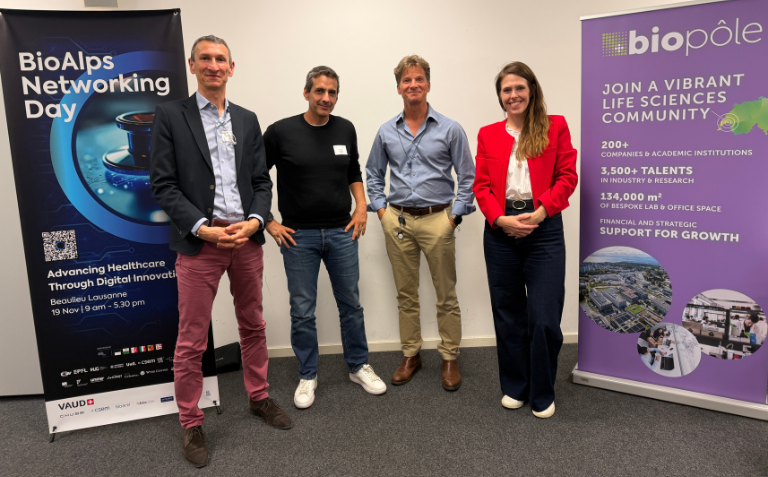
Ready to sell? What it really takes to go from innovation to commercialisation.Your product is approved. Now what? On 5 October 2026, BioAlps and Biopôle brought about 40 founders, investors and ecosystem partners together at Biopôle in Lausanne for a Deep Dive on one of the hardest steps in a life sciences company’s journey: the commercial transition.
The discussion was led by Magali Bischof, Secretary General of BioAlps – Swiss Health Valley, and Pierre-Jean Wipff, Innovation and Partnerships Director at Biopôle. They were joined by two founders who have lived this transition first-hand: Patrick Pestalozzi, CEO of Abionic, and Mathieu Horras, CEO and Founder of Aspivix. Their message was clear from the start: designing and engineering the product may turn out to be the easier part. Here a few take aways.
1. The market decides, not the regulator
Regulatory approval is only the beginning. Clinical validation, certification, reimbursement, procurement and market access determine whether a technology becomes a business. Evidence generation does not stop at launch: clinical studies, real-world evidence and post-market surveillance continue.
Market access must shape strategy early. Every country is different, and pricing, reimbursement and healthcare economics can make an attractive market unviable. Aspivix’s experience in the US showed how reimbursement pathways and patient coverage can reshape a planned business model. Knowing who pays, how they pay and what value they recognise matters as much as knowing who uses the product.
A first sale is a different kind of proof. Until someone pays, assumptions about demand remain assumptions. Commercialisation tests the value proposition, pricing, purchasing pathway and sales model, not only the technology.
Choose your sales channels carefully. Distributors do not automatically know how to launch an innovative product. Selecting the right partners, setting the right terms and learning from their market experience are critical. Sometimes it is wiser to crack one market and one sales model first, then scale.
2. Mind the money gap
Prepare for the post-approval “mini Death Valley”. Clearance does not translate into revenue overnight. Companies need enough runway to bridge approval, launch, reimbursement and meaningful sales. The investment story also changes: investors stop buying promises of future sales and start judging actual commercial performance.
Consolidate the commercial promise before launching. Once sales begin, expectations become measurable. Positioning, value proposition, evidence and commercial assumptions should be challenged and strengthened before entering the market.
3. Build the company around the product
Commercialisation transforms the whole company. It moves from burning cash to generating it, from technical teams to customer-facing ones, and from a shared office to teams spread across markets and clients. Keeping everyone aligned becomes a leadership priority.
Scaling needs a new operational backbone. Logistics, CRM and ERP integration, inventory management, manufacturing partners and 3PL providers become mission-critical. In medtech, even running out of stock can become a quality or compliance issue.
Culture has to scale too. With dispersed teams and different priorities, alignment does not happen by itself. Shared objectives, visible KPIs and deliberate work on communication and listening help. The CEO’s role shifts from decision-maker to orchestrator, making sure the right people can decide without the CEO becoming the bottleneck.
Evolve governance before it becomes urgent. The board that carried a company through R&D and fundraising may not be the one it needs to scale commercially. Board transitions take time, so companies should anticipate the expertise they will need next.
The overarching message
Being ready to sell is very different from having a product ready to sell.
The commercial transition asks companies to rethink market access, evidence, pricing, sales channels, financing, operations, governance, leadership and culture, all at the same time. The technology remains essential. But successful commercialisation depends on building the organisation and the ecosystem around it.
Many thanks to Patrick Pestalozzi and Mathieu Horras for sharing their experience so openly, to Biopôle for hosting, and to everyone who joined the discussion.