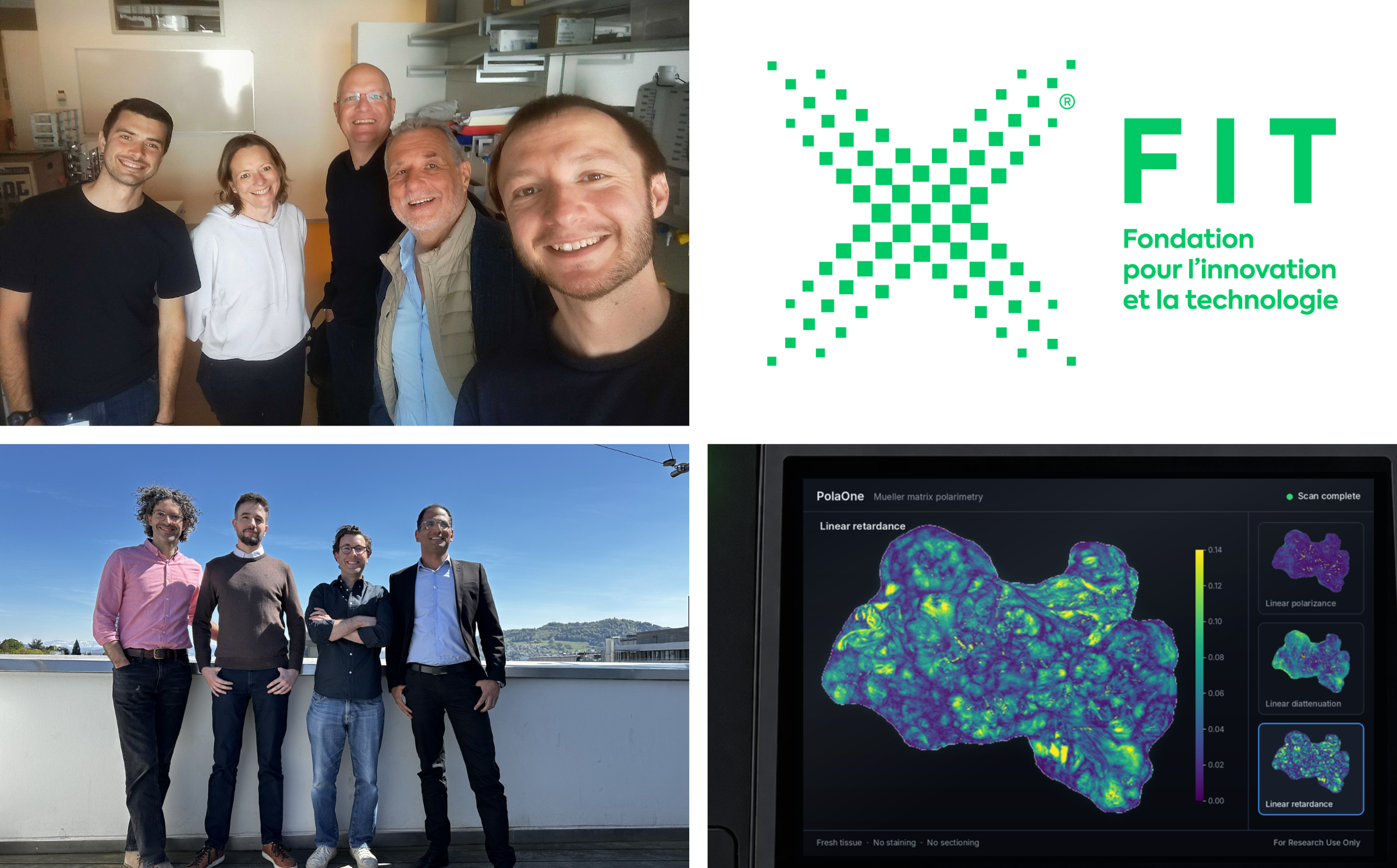
Biodelphis Therapeutics, PolaSight and Swiss Soil each receive a Tech Seed loan

Share this article
The Foundation for Innovation and Technology (FIT) is supporting three life sciences start-ups through Tech Seed loans. Biodelphis Therapeutics is receiving CHF 100’000 to advance its targeted treatment for osteoporosis. PolaSight has been awarded a loan of CHF 100’000 to prepare for the market launch
of its scanner, which helps pathologists analyse tissue samples taken during cancer surgery more quickly. Swiss Soil has also been awarded CHF 100’000 to conduct field trials of its vineyard management system, which continuously monitors the soil and vines.
Biodelphis Therapeutics: medicines that act only where they are needed
Bone is constantly being renewed: some cells break it down whilst others rebuild it. In osteoporosis, the breakdown process takes over and the bones become brittle. To slow down this process, it is possible to block a protein in these cells called cathepsin K. However, five drugs of this type have been discontinued during development, including one in the final phase of clinical trials due to an increased risk of stroke. These drugs, in fact, acted throughout the entire body.
Spun out of EPFL, Biodelphis Therapeutics attaches a small inhibitory peptide to an antibody. This antibody acts as a carrier, delivering the molecule exclusively to the cells that break down bone, thereby sparing healthy tissue. The start-up is applying the same approach to lung cancer. Its first drug candidates have already demonstrated their efficacy in animal studies.
Thanks to the CHF 100’000 Tech Seed loan granted by the FIT, Biodelphis Therapeutics will be able to demonstrate that its treatment for osteoporosis does not increase the risk of stroke. It will also be able to conduct an initial study into how the drug behaves in the body. These steps pave the way for the studies that must precede the first human trials.
PolaSight: faster diagnosis during cancer surgery
PolaSight, a University of Bern spin-off, has been awarded a CHF 100’000 Tech Seed loan from FIT to bring its tissue diagnostic platform, PolaOne, into hospitals.
During cancer surgery, key decisions often depend on a tissue sample sent to a pathologist, such as whether more tissue needs to be removed. The standard rapid analysis, called frozen section, usually takes 20 to 40 minutes. The patient stays under anaesthesia, and the surgical team waits for the result. Because the tissue has to be frozen and cut, only a small part of the sample can be examined.
PolaOne is designed to change this. In about 60 seconds, it produces a map of the entire fresh sample to help the pathologist decide where to look first. No stains are needed and the tissue stays intact, so it can then go through the usual analysis following surgery.
For patients, this could mean less time under anaesthesia and a more complete assessment of the tissue removed, with the goal of reducing the need for a second operation. For surgeons and pathologists, the aim is faster and better-informed decisions at the moment they matter most.
PolaOne is already used for research in different pathology laboratories, where it is collecting data on fresh tissue samples to support its clinical validation.
With FIT’s support, PolaSight will complete CE marking, which is required to use PolaOne in European hospitals and is targeted for early 2027. The loan will also fund preparations for its first hospital installations.
Swiss Soil: a system that continuously monitors the health of vineyards
Swiss Soil manages vineyards on behalf of winegrowers. To this end, it has developed AGROSTASIS. A thermostat maintains a single value: temperature. AGROSTASIS, by contrast, seeks to maintain a balance between numerous factors simultaneously. The system combines soil and sap analyses, weather data and images captured by an automated microscope. Using this data, it assesses the condition of the soil and the vines, identifies signs of stress or nutrient deficiency, and indicates where to take samples and how to intervene. The Swiss Soil teams carry out the sampling and interventions in the field. This means the winegrower does not need to master any tools.
The three main components of the system are already operational. They were developed in collaboration with HEIG VD and ETH Zurich, amongst others. In July 2026, Innosuisse approved a two-year project carried out in partnership with the Changins School of Viticulture to test the complete system in vineyards under real-world conditions in 2027 and 2028. Swiss Soil has already signed ten letters of intent and is aiming for a commercial launch in 2028.
Thanks to the CHF 100’000 Tech Seed loan granted by FIT, Swiss Soil will be able to fund its CHF 66’000 contribution to this Innosuisse project and incorporate as a public limited company with a view to raising its first round of funding. This funding also enables the release of CHF 100’000 in support granted by the Canton of Vaud.
➡️ Source: FIT Press Release | 📸 © Polasight, FIT, Biodelphis Therapeutics