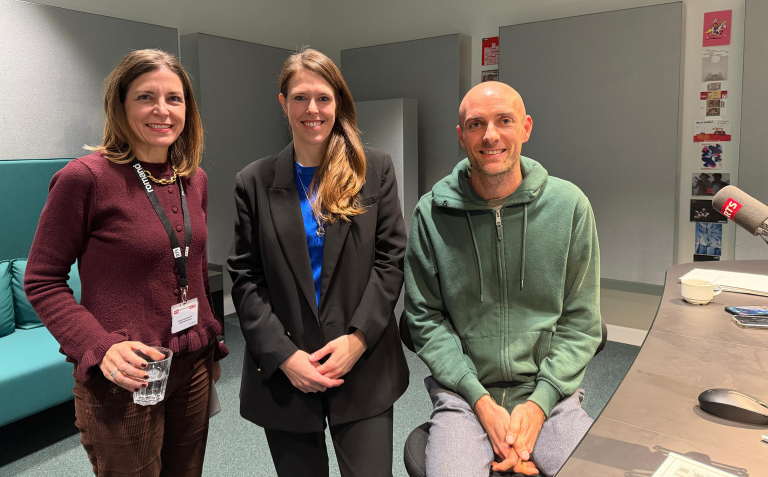
Swiss Health Valley on La Matinale RTS

Share this article
On 14 October, Magali Bischof, Secretary General of Swiss Health Valley by BioAlps, was the guest of La Matinale on RTS La 1ère. The question on the table: are life sciences the new golden goose of French-speaking Switzerland?
“No, it’s not an exaggeration,” she answered. “But it’s not new either. This industry has been present in the region for a long time.” What the recent BAK Economics study does, she explained, is shed light on something the public does not always realise.
The numbers are striking:
- More than 1,900 companies across six cantons: Fribourg, Geneva, Jura, Neuchâtel, Valais and Vaud
- At least 38,000 jobs in the life sciences in Western Switzerland
- +55% employment between 2015 and 2025
- One job in the sector creates roughly one more in other industries
What’s behind the jargon
Magali Bischof began by unpacking the term. Life sciences bring together biology, chemistry, physics and data science to understand how life works, and to develop therapies. In the region, that means concrete companies:
- Lonza in Visp employs 6,000 people and has recruited more than 3,000 in the past three years, around 100 a month.
- Haleon in Nyon employs 1,100 people and produces 300 million units of medicines a year, including well-known brands such as Voltaren and Otrivin.
- Merck in Corsier-sur-Vevey employs around 1,000 people and manufactures active ingredients for biological medicines in oncology, multiple sclerosis, fertility and growth, with bioreactors of 150,000 litres.
- OM Pharma in Geneva develops preventive treatments for bronchitis and urinary tract infections based on bacterial lysats.
- Medtronic, which has just celebrated 50 years in Switzerland, has produced 10 million implants on the shores of Lake Geneva, at a rate of 2,000 devices a day, and especially pacemakers.
- SOPHiA GENETICS is one of the leaders in data-driven medicine.
- Corden Pharma produces tablets and capsules for several brands, and also the famous Algifor;
- Alcon makes contact lenses;
- Jabil is a world leader in spinal implants and surgical instruments;
- IMA Automation designs production and packaging lines.
At around all these big names, hundreds of companies active in medtech, biotech, pharma, digital health, nutrition, cosmetics and vetenary health. You can find them in the Swiss Health Valley Directory.
Startups and innovation parks
Around these large groups grows a dense network of SMEs and startups, many of them spin-offs from the region’s universities. They find a home in innovation parks spread across the region:
- Biopôle in Lausanne: 200 companies and 2,500 employees.
- Campus Biotech in Geneva: researchers in neurotechnology and neurology, patients and entrepreneurs working side by side, with cutting-edge technical platforms.
- BioArk in Monthey and Visp, including the Swiss Biotech Center in Monthey, which helps young biotechs move from the lab to pre-industrial quantities.
- Microcity in Neuchâtel, with a focus on diagnostics.
Cantonal initiatives complete the picture, such as Biotools, run by Innovaud, Biopôle and BioAlps to support young life sciences companies, and the food cluster in the canton of Fribourg.
Western Switzerland and Basel: partners, not rivals
Asked whether the region has overtaken Basel, Magali Bischof preferred to speak of complementarity. “We are two regions in a small country that work well together, with different approaches and strengths.” Basel is home to large groups, while Western Switzerland relies on a wider territory and a dense fabric of smaller companies. That diversity makes partnerships easier and drives innovation.
Keeping innovation in Switzerland
Much is developed here but not always used here. Magali Bischof stressed that the bilateral agreements and the ongoing discussions with the European Union are essential for market access. Without them, technologies tend to turn to the American market first.
To attract and retain companies, Switzerland can count on political and economic stability, an exceptional quality of life, a strong talent pool and tax tools for research and development introduced by the RFFA reform.
A call to young people
The sector needs talent. Lonza alone has recruited more than 3,000 people in three years in Visp. Many jobs are in chemical production technology, where dual vocational training could be pushed further. Companies offer apprenticeships, but not enough young people fill them. The message is clear: life sciences are a sector with a future.
See you at the BioAlps Networking Day
The conversation continues at the BioAlps Networking Day, on 19 November at the Palais de Beaulieu in Lausanne, with 500 participants expected. The morning will spotlight innovation from the canton of Vaud. The afternoon will explore how digital innovation can support caregivers rather than add to their workload, and how it can serve patients, with a patient representative joining the discussion.
As Magali Bischof put it: “That’s why we are here.”
🎙️Listen to the full interview (in French)
➡️ Register for the BioAlps Networking Day
🙏🏻Warm thanks to the La Matinale team, and espacially Delphine Gendre and Yann Amedro at RTS for the invitation.