ABILITY Neurotech Receives IMDD Approval to Start Clinical Trial for Chronic Implantation of BCI in ALS Patients

Share this article
ABILITY Neurotech, a Geneva-based clinical-stage brain-computer interface company, announced it has received Investigational Medical Device Dossier (IMDD) approval from the Medical Research Ethics Committee (MREC) NedMec in the Netherlands to launch its first chronic implantation study of a fully implantable wireless optical-link ECoG BCI in amyotrophic lateral sclerosis (ALS) patients.
This milestone represents the company’s transition from intra-operative testing into long-term clinical investigation, marking the initial human use of its implantable platform for extended periods. The approval acknowledges comprehensive preclinical data, biocompatibility assessments, safety protocols, software validation, and risk management strategies aligned with European Medical Device Regulation requirements.
The research will take place at UMC Utrecht (University Medical Center Utrecht, Netherlands) under the INTRECOM consortium, which includes UMC Utrecht, the Technical University of Graz (Austria), ABILITY Neurotech, and CorTec. The study aims to evaluate the BCI’s performance as a home-use system for restoring communication and speech in ALS patients.
CEO Rotem Kopel stated: “Receiving approval for our first chronic implantation study is a defining moment for both ABILITY and for the broader BCI field.” She emphasized the system’s potential to move beyond controlled environments toward practical, patient-centric applications.
ABILITY’s platform features a 50 Mb/s transcutaneous optical link enabling raw, broadband neural data streaming previously unachievable in fully implantable, battery-free devices. The technology captures complete cortical activity and supports AI-driven applications for autonomous text generation and real-time communication.
Mariska Vansteensel, PhD and clinical lead at UMC Utrecht, noted: “For patients with severe motor impairment, the loss of communication is devastating.” She highlighted implantable BCIs’ significance in restoring interaction and independence.
The study will complement ABILITY’s ongoing intra-operative evaluation program at the Technical University of Munich, establishing a dual-track clinical strategy combining acute signal analysis with chronic device performance assessment.
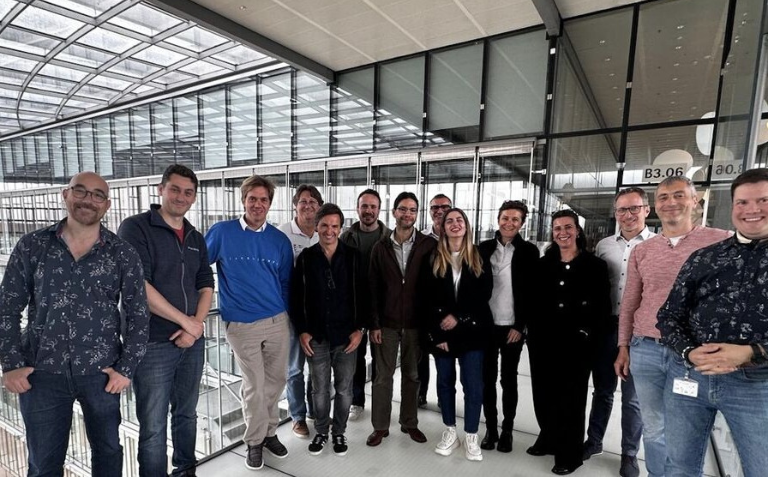
➡️ Source: Press Release | 📸 ABILITY’s team, ©ABILITY